A busway system is an engineered system for distributing electrical power, also called bus duct or busbar trunking system. It has enclosed busbars, usually made of copper or aluminum, that efficiently carry electricity.
The busSTRUT track busway utilizes copper busbars. Electrical conductivity and reliability is higher in copper than aluminum.
What is the voltage rating of a busway system?
Electrical standards identify busway systems as low, medium, or high voltage.
busSTRUT track busway is a low voltage busway listed for up to 600V (the common voltage range in North America is 120 or 277V).
What are the standards for busway?
UL 857 and NEC Article 368 are both important standards for busway electrical power distribution systems.
The National Electrical Code (NEC) ensures safe installation of electrical wiring and equipment. While Underwriters Laboratories (UL) creates the standards that specify construction, performance, and safety criteria of manufactured products.
A nationally recognized testing laboratory (NRTL) in Intertek lists the busSTRUT track to UL standards for low voltage busways. Building inspectors acknowledge an NRTL listing for a product’s safety.
What is the difference between busbars and busways?
A busbar is a strip or bar of copper, brass, or aluminum that conducts electricity within the busway.
busSTRUT arrives pre-fabricated with (3) copper #8AWG busbars.
What is the difference between busways and busSTRUT?
busSTRUT is a busway with a continuous access slot enclosed in steel formed to the shape of strut. This lower amperage busway is most cost-effective and flexible.
In addition to dropping power, busway lighting is now cost-effective. No longer should you see commercial lighting track mounted to un-wired steel strut. busSTRUT is pre-wired strut that is a cost-effective bus bar system.
How does a busway system work?
A busway system has conductors made of copper or aluminum inside a protective housing. You can easily install and re-install various types of power connections, including lighting with plug-in busways.
busSTRUT track busway is a plug-in busway offering immense flexibility in configuring your space to specific requirements.
What is the difference between feeder style and plug-in style busway?
The main difference is in the amount of flexibility required. Feeder busway is for long-distance power transmission, whereas plug-in style for flexible power distribution with many access points.
Feeder Style Busways transmit large amounts of power from one point to another. If there is no need for plug-ins or tap-off points, a feeder style busway may be appropriate.
Plug-in style busways provide plug-in units power from pre-fabricated slots or tap-off points. Various points along a plug-in busway can power electrical equipment, including lights. Plug-in busways are flexible and can easily add, remove, or move power and lighting to match the space’s needs.
The most flexible plug-in busway is busSTRUT. Traditional plug-in style busways only allow tapping off power at specific intervals. In contrast, busSTRUT engineered track busway with continuous open slot accessibility, which allows tapping into the system anywhere!
What are the different components of busSTRUT’s One System? Here’s an overview on the few modular components required for a complete flexible busSTRUT system.
Runs – the parts needed for a complete run of busSTRUT include the pre-wired strut busway, hangers, and joiners. These foundational components are everything needed to suspend rows or columns of the pre-fabricated power distribution network.
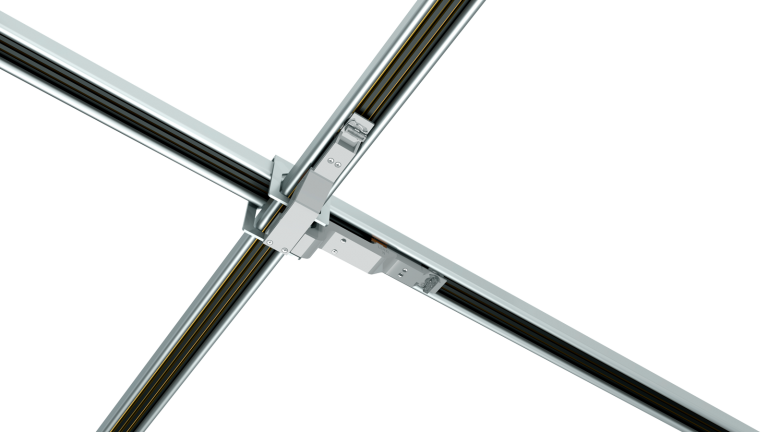
Crossover: The mechanical intersection component that plays a crucial role in the system’s versatility. This over/under mechanical intersection accommodates virtually unlimited layout spacing options, while also allowing for future changes in layout.
Jumper: The electrical intersection component that energizes an entire perpendicular row or column. Only one pre-fabricated electrical jumper is needed for an entire row or column. This electrical intercept connector enhances the system’s flexibility in power distribution. By these minimal amount of electrical jumpers needed, the installation process is easier and future re-circuiting is quickly feasible.
Feed: The component type that brings power to the busSTRUT system from the building’s back-panel electrical power, thereby energizing the attachments to the busSTRUT.
Attachments: Lighting, power, data, and decor attachments to the busSTRUT are available.
Lighting: busSTRUT can support all types of lighting fixtures in pendants, linear lights, and accents on the same ONE System. Various types of accent and linear light fixtures are available directly from busSTRUT with pre-wired fittings. Additionally, we allow for the integration of other manufacturer’s canopy mounted lights via a busSTRUT READY OCTAGON BOX.
Power: You can power all types of devices on/below the busSTRUT. Our fitting with built-in receptacle may power equipment mounted directly to the busSTRUT, including displays / sensors. To electrify devices below the busSTRUT, we manufacture power-tap boxes, drop cords, and power poles. Typically power to the floor is from busSTRUT power taps with floor operable disconnect breaker.
Data and AV Capabilities: busSTRUT provides the necessary attachments and networking equipment for audio-visual devices supplied by others.
Decor: The busSTRUT steel housing supports decorative elements like signs, faux wood, wire mesh, and sound panels.
How is busway installed?
The specific installation procedures can vary depending on the type of busway. The following is a general overview of the busway installation process:
Mounting Supports: Install supports or hangers that will hold the busway.
busSTRUT manufactures aircraft cables for attachment to structure. Our cables comes with pre-installed ¼-20 eye bolt for use with various types of fasteners.
Assembling Sections: Connect the busway sections together. This involves securing the suspended sections together with pre-fabricated joiners and X, T, or L intercepts (also known as “elbows” and “tees”).
Elbows and tees are typically difficult to install, and an X connector is almost impossible. However, busSTRUT track busway intersections require no in-field wiring. A busSTRUT slimline jumper clips onto a mechanical crossover intercept as needed. The image below shows this busSTRUT mechanical and electrical intersection that does not require any in-field wiring.
Installing end caps: Busways typically have exposed copper at the ends of each length. The exposed copper typically supplies power to abutting lengths using joiners. Where there are no joiners installed, typically end caps are installed for safety on the open ends of each row or column of the busway.
Another unique feature of busSTRUT track busway is that each length we manufacture comes with end-caps pre-installed. busSTRUT engineered an electrical joiner connector that bypasses the end caps – maximizing safety and eliminating the need for end-caps to be separately sold.
Electrical Connections: Busway’s higher ampacity reduces the amount of feeds required. Those few hard-wired electrical connections to the panel are critical.
Busway branch circuits are typically greater than a traditional 20amp circuit. With higher ampacity, comes larger pipe-and-wire and panels that may be costly.
Unique to busSTRUT busway is our lower ampacity. We manufacture 20amp and 40amp sections that work seamlessly together. busSTRUT/40 trunking distributes power to the busSTRUT/20 branches for plug-ins. With busSTRUT 20amp track busway, you avoid the need for the costly fuses traditionally required on busway plug-ins. The National Electrical Code requires all plug-ins mated with busways exceeding 20amps to be fused.
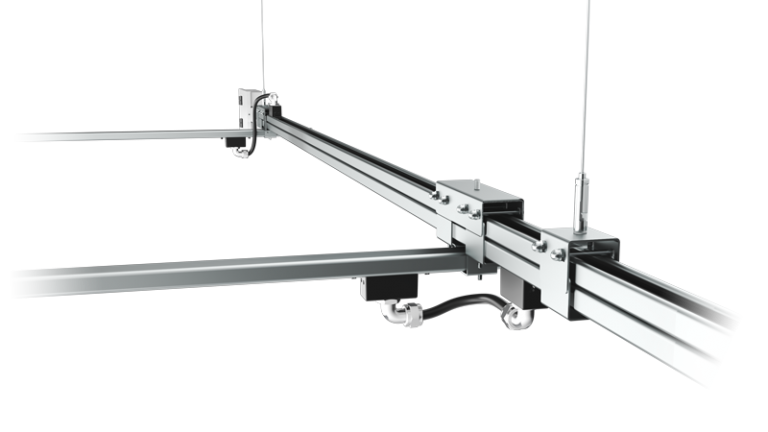
Double-decked busSTRUT/40 powers the busSTRUT/20 branches in the image below.
Attachments: For plug-in style busways, you can add plug-in units or tap-off boxes anywhere along the busway.
busSTRUT track busway is a plug-in style busway with Plug & Play fittings.
What lighting fixtures are for use with the busSTRUT track busway system?
The busSTRUT system is compatible with all types of light fixtures. Typical lighting fixtures attached to busSTRUT include linear general lights, commercial track lights, and decorative / industrial style pendants.
What weight can I support from busway systems?
The manufacturer of the busway system will provide specifications for the maximum load capacity. Different busway designs (feeder, plug-in, compact, etc.) have varying load capacities.
busSTRUT track busway is a compact busway listed for up to 100 pounds between support points. The mechanical load of the system needs to be considered, in addition to the weight of the supported devices.
The quantity of support points determines the total weight capacity of a busway system. The busSTRUT track busway system enables the addition of support points anywhere along the track busway, allowing nearly limitless weight capacity via additional hangers.
How often does busway need to be supported?
The primary reference for support intervals should always be the engineer of record and manufacturer’s installation guidelines. Different busway systems may have varying structural requirements. In most cases, busways require regular intervals of support from 4 to 10 feet.
The busSTRUT track busway system is listed for up to 10 feet between support points.
How safe is the open slot accessibility of busSTRUT track busway?
busSTRUT track busway features a continuous insulator that complies with the UL “Finger Safe Probe” standard. The busSTRUT has three copper wires embedded in our extruded insulator.
Can anyone move the lighting fixtures and power drops on busSTRUT?
A layperson, such as store employees with the proper training, can move busSTRUT’s light fixture and power drops.
You do not need any tools to install busSTRUT’s light fixtures and power drops. Simply insert the associated busSTRUT fitting into the the busSTRUT track busway and rotate the two knobs. Note some fittings might also require mounting bolts are installed for added safety.
As part of the training, busSTRUT suggests as a pre-caution that power is turned-off when fittings are moved.
What are the advantages of busway systems compared to other electrical distribution systems?
Busway systems stand out for their adaptability, space-saving design, installation ease, safety, and minimal maintenance needs. These advantages make them a forward-thinking solution for modern electrical power distribution challenges. Busway systems have numerous advantages, including the following:
Adaptability and Scalability – Busway are incredibly suitable for environments where needs may vary, or evolve over time. Busway systems make building modifications and/or expansions simple. Adding or relocating attachments to the busway, or even extending the busway itself – requires no major overhauls. Busway systems can grow and change along with the needs of the facility.
Enhanced Aesthetic and Space Efficiency – Busways may be more compact compared to conventional cable distribution systems.
busSTRUT track busway is compact, with a slim profile of 1″ deep and 1-5/8″ wide. busSTRUT blends well with a building’s design, and is available in various finishes. busSTRUT track busway offers a cleaner and more organized look, which is particularly beneficial in open-ceiling designs.
Reduced Installation Time – One of the most notable benefits of busway systems is the reduced installation time. Being a pre-engineered electrical distribution system, busways significantly cut down on labor and installation costs. Not only are busways more cost effective in the long run, but also to adapt to futurechanges.
busSTRUT offers a complimentary installation drawing set when we initially quote a project. With those project-specific quantities, and proven time-standards for each component, busSTRUT guarantees a pre-determined labor cost.
Improved Safety – From a safety perspective, busways offer improved protection. Their enclosed design reduces the risk of electrical hazards, ensuring safer operation and maintenance. This is a critical factor in environments where safety is paramount.
Being a pre-engineered system, busSTRUT eliminates contractor discretion.
Minimal Maintenance – Busways require minimal maintenance. Being pre-engineered and with fewer potential points of failure, busways are more reliable than traditional methods.
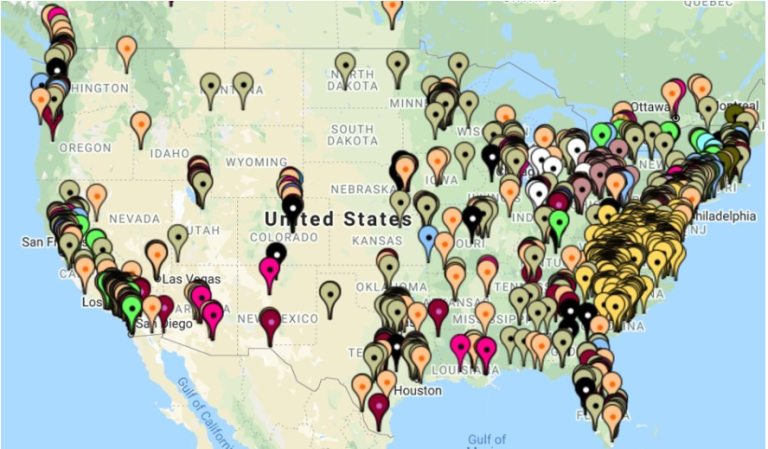
Thousands of projects, including Fortune 50 companies, suspend busSTRUT overhead for power distribution.
What are the dis-advantages of busway systems compared to other electrical distribution systems?
Initial Cost – Purchasing a specialized busway system can appear more costly. However, the significantly reduced electrical (conduit / circuitry) and mechanical (unwired steel strut / kindorff) materials need considered. Typically, the cost of these traditional materials are not broken out in a sub-contractor’s bid. In addition to breaking out the materials, please consider breaking out the labor to install. Suspending a busway system eliminates a significant amount of in-field wiring, and thus should ultimately be significantly less expensive once considering total installed cost (material + labor, the only cost that matters).
busSTRUT invested heavily in machinery to manufacture the world’s lowest cost busway. Your busway system’s material costs are now similar to conventional materials, with the added benefit of reduced labor costs.
Installation Constraints- While the installation process is quicker, you need to plan for precisely mounting the sections.
With busSTRUT track busway’s highly engineered intersections – lengths of busSTRUT can precisely slid into place.
Environmental Limitations- Busways may not be suitable for harsh environmental conditions.
busSTRUT track busway offers a closure strip for enhanced protection.
Limited Vendor Options – Availability may be limited, as there are a limited number of busway manufacturers.
Thankfully, busSTRUT builds our busway to stock in Ohio; and has been in business for more than twenty years. Additionally, busSTRUT is a manufacturer that prides ourselves on being “Customer Obsessed”. We offer complimentary services including detailed project-specific installation drawings and installation project managers.
Where is busway used? What are the different applications for busway systems?
Suspended busways are in many different applications because they are flexible, sustainable, and easy to install. Applications where busways may be used for lighting, power, data, and/or décor include the following environments:
Manufacturing Facilities – Busways provide power to equipment where layout changes in industrial plants is invaluable.
Warehouses and Distribution Centers – Busways allow for efficient power distribution across expansive areas.
Data Centers – Data centers often undergo expansions or re-configurations. Busways provide the ability to easily add or move power distribution points without major infrastructural changes.
Starline busways range up to an astounding 1,200amps in order to power servers in cloud facilities around the world. In contrast, busSTRUT track busway is the leader in low amperage (i.e. normal commercial) projects.
Office Workplaces – Busways facilitate the distribution of power and data cabling, adapting to changing office layouts and power needs.
Retail Stores – Busways provide a flexible solution for lighting and powering displays in retail spaces.
Hospitals and Healthcare Facilities – Busways ensure reliable power distribution crucial for medical equipment and patient care areas, offering flexibility for evolving medical technology needs.
Educational and Public Buildings – Busways are often suspended in school university classrooms, laboratories, libraries, and other learning environments where flexible and safe power distribution is valuable.
Public Facilities – Museums suspend lighting busways because the adaptability of power sources is essential for changing exhibits, events, or public services.
High-Ceiling Spaces – With labor efficiencies being critical in large open spaces, busways are suspended in high ceiling environments like auditoriums, theaters, and exhibition halls.
Laboratories – Busways are an organized method for power distribution, and that is essential in these critical environments.
Historical Buildings: In renovation projects where preserving the integrity of the structure is crucial, busways offer a less invasive method for flexible power distribution.